5G Core#
Introduction#
Unryo provides assurance, correlation and root-cause analysis for the 5G Core. It is not another telemetry store: instead of copying your data, it connects to the systems you already run, the passive monitoring sources that observe SBI traffic, the metrics backends that watch the cloud-native infrastructure, and your OSS systems, which provide service, inventory and assurance context, and correlates across all of them with live topology context to explain service health, impact and root cause.
The solution is vendor-agnostic, 3GPP-compliant, and supports all 5G 3GPP core network functions. Its cloud-native architecture scales the analysis with the volume of control-plane signaling. Where Unryo is the right place to hold the data, such as SBI message records, it ingests and stores them directly; otherwise it reads from your existing record stores, metrics endpoints and OSS rather than duplicating them.
It provides the following telecom use-cases:
- SBI Traffic Analysis, from probes, packet brokers or existing record stores
- Kubernetes Monitoring, to monitor the underlying infrastructure
- Processing and enrichment of CNF messages, following the 3GPP Service-Based Architecture (SBA)
- Best-Practice KPIs & dashboards on the 5G Core and Kubernetes layers
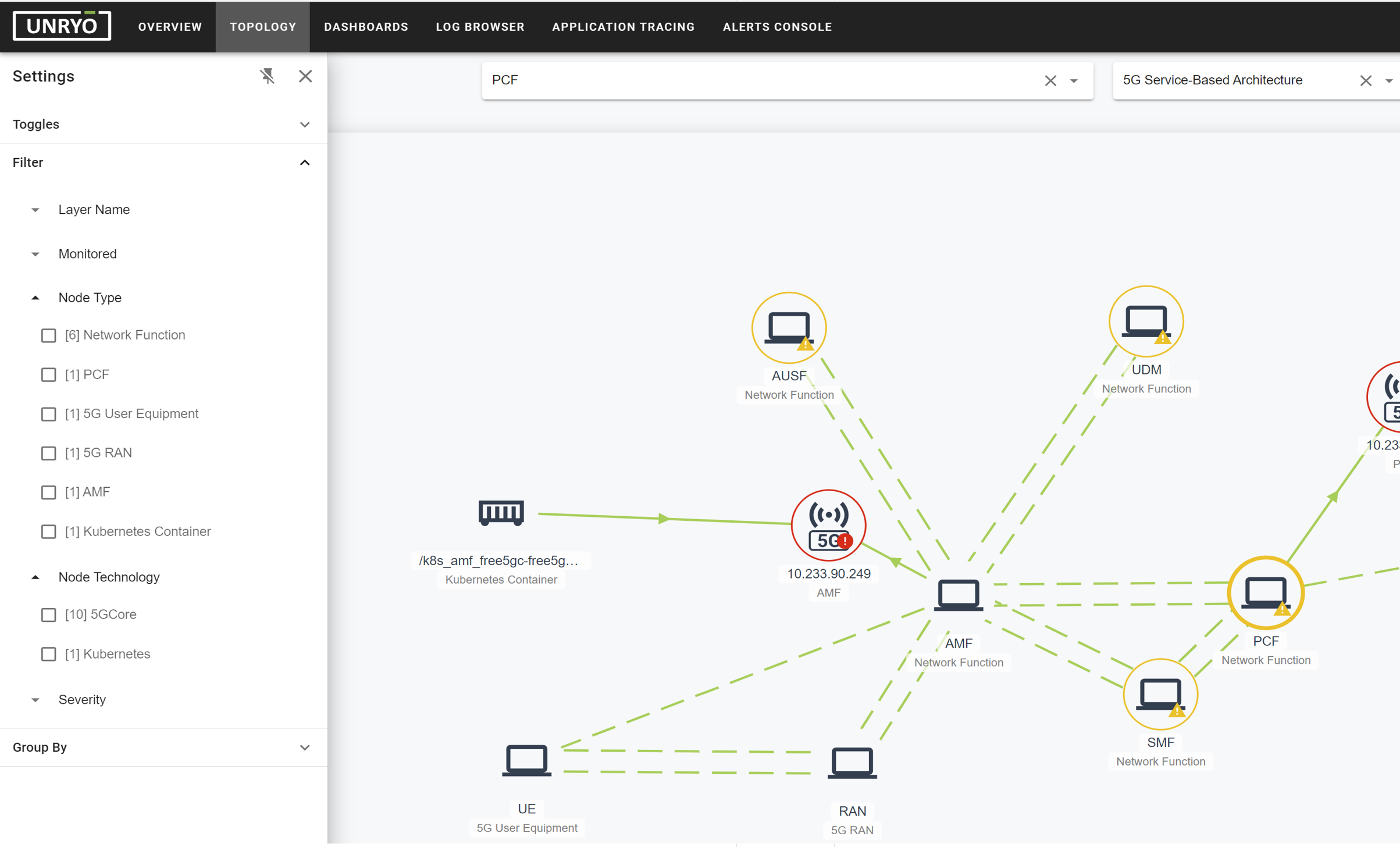
- 5G Core Topology Maps, multi-layer and built dynamically from ingested data
- Cross-domain RCA / Impact Correlation, relating Kubernetes infrastructure issues to 5G service impact
- Service Monitoring, with configurable service hierarchies and SLO/SLA
- Customizable Alarm Console for NOC teams, with the most common notification channels
- AI-driven troubleshooting, using ML and agentic AI to speed up resolution
Analysis of SBI traffic#
Unryo analyzes the 5G Core control plane from passively-captured Service-Based Interface (SBI) message records. These records are produced by passive monitoring sources that observe the SBI traffic between control-plane network functions, such as virtual probes, physical probes, or packet brokers.
Depending on your architecture, Unryo supports two ingestion modes:
- Receive from the source: Unryo collectors receive the records directly from the probes or packet brokers (for example as JSON-encoded messages) and store them in its log engine.
- Connect to a data store: where the probes or packet brokers already write their records to an existing data store, Unryo connects to that store and reads the records from it.
In both cases the records are normalized and made available for the processing, enrichment, KPI computation and topology learning described below.
Kubernetes Monitoring#
In parallel, Unryo monitors the underlying Kubernetes infrastructure. The preferred integration is to connect to your existing Prometheus endpoint(s). Prometheus-compatible endpoints such as VictoriaMetrics, Thanos and Cortex are consumed the same way, and where Prometheus is not available, Unryo can poll the Kubernetes API directly.
Depending on your architecture, you can also extend visibility and correlation to other domains and telemetry data, such as network flows, service meshes, OpenTelemetry, and custom third-party data sources.
Processing and enrichment of CNFs messages#
Unryo extracts in real time the important metadata from the messages and enriches them with 3GPP service information such as service name, service operation and other tags, based on the SBI path and method.
Best-Practice KPIs & Dashboards#
KPIs are computed from the ingested log aggregates and stored in a time-series database for fast queries. Dashboards present this information both in real time and over historical periods:
- 5G Core control plane: SBI success rates, traffic volumes, latencies and error rates, per network function and service operation
- Kubernetes: node, pod and container health, resource usage and restarts
- Cross-layer views correlating 5G Core service health with the underlying Kubernetes infrastructure
5G Core Topology Maps#
Multi-layer 5G topology maps, automatically learned from the SBI message feed.
- NF-to-NF traffic
- 5G Service-Based Architecture
- NF-to-Kubernetes
- NF-to-probes
- Service Topology Maps
- Custom Maps
Dependencies between CNF components are learned automatically, across multiple layers: